Nerds and geeks come out to play
(Filed: 20/05/2006)
[image]
Thanks to a bestselling book, Tokyo's world-shy technophiles are coming out of their bedrooms and into the high streets writes Benjamin Secher.
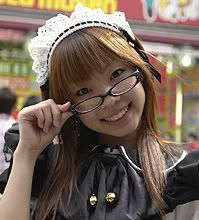
'Welcome home, sir': customers go to maid cafés to be mollycoddled, and to play children's games with the maids
The busy café, above a computer shop in central Tokyo, is called Diana du Cupid; the girl who opens the door is dressed as a Victorian maid. In her frilly lace hat and immaculate white apron, she's pretty convincing, although the thigh-high skirt and black leather boots are a little incongruous.
"Welcome home, sir!" she says, with a smile - even though I've never been here before - then ushers me into a room filled with more maids, serving tea and chat to a mainly male, adult clientele. It looks like a scene from a cartoon come to life and, in a way, that's exactly what it is.
Maid cafés, which are springing up across Japan, are just one sign of the latest cultural boom to grip the nation: the rise of the otaku. A largely invisible subsection of Japanese society, otaku are the legions of agoraphobic technophiles who, from the obscurity of their bedrooms, fuel the country's multi-million-pound markets for video games, anime (animated cartoons) and manga (comic books). They have long been demonised by the media, their self-centred, anti-social approach to life blamed for everything from the declining economy to the disintegration of the family unit. But, two years ago, along came a book that changed everything.
First published in 2004, Densha Otoko ("Train Man") is the "real love story" of a painfully shy computer programmer and a sophisticated woman whom he meets on a train. A peculiarly Japanese twist on the beauty and the beast myth, it was written in the style of an internet chatroom exchange - the postings of a hapless nerd negotiating his first romance, running alongside the encouraging responses of an anonymous community of online "friends".
Although it feels a little like Bridget Jones's Diary as written by a jargon-obsessed IT student, it became one of the year's best-sellers, shifting 1.5 million copies in nine months. A smash-hit film adaptation and prime-time TV series followed. In each reincarnation, the spluttering otaku hero was treated not with the disdain that has been traditionally heaped on his sort, but with affection.
The phenomenal success of the book and its spin-offs rocketed otaku culture into the mainstream, making it acceptable, even desirable, to be openly nerdish. Discerning Tokyo youths have started swapping their designer shades for bottle-bottom spectacles, taking their girls for dates in Akihabara, a neighbourhood lined with electronic emporia.
Businesses rooted in the otaku aesthetic are duly claiming their place on the high street: none with more fanfare than the maid café. The concept is a simple, if strange, one. Customers go to these cafés to be mollycoddled, to drink tea and play children's games with one of the maids. It's not about sex, but about escapism: the maid outfits are inspired by a standard cutesy cartoon character; the customer gets to play the fictional hero.
It would be tempting to dismiss the otaku boom as just another of those oddities that come and go in modern Japan, but the enduring popularity of Densha Otoko suggests that it runs deeper. Shy, sensitive, unfeasibly knowledgeable about microchips, the otaku male may yet become as potent and curious an icon of noughties Japan as the overworked salaryman was in the 1980s.
Information appearing on telegraph.co.uk is the copyright of Telegraph Group Limited and must not be reproduced in any medium without licence. For the full copyright statement see Copyright